
Ship backend systems 5x faster. Build the AI-native services companies are actually hiring for.
You already use AI. What you're doing is the surface. Below it: spec-driven workflows, local and cloud coding agents, RAG, embeddings, tool-calling agents, and production AI backends. This is how AI-native engineers really work, and why they're the ones getting hired, promoted, and paid.
Take the first lesson free - right now
See the teaching level for yourself - then keep going.
Who teaches it

Abdullah Hatem
Founder & President of Catalyst · ex-Senior SWE at top companies
Founder & President of Catalyst and former Senior Software Engineer at Breadfast, Lasting Dynamics (Spain), GiveSync (America), and Vodafone, who has built backend systems handling millions of requests across the world, interviewed and hired engineers at top companies, and now teaches engineers how to ship AI-native systems the way they're actually built in production.
See more on LinkedIn ↗What you'll master
The things that separate you from everyone else.
Agents that ship, not autocomplete
A structured spec → agent → review workflow instead of random prompting.
- Turn requirements into specs agents build from
- Ship APIs, schemas, migrations & tests with agents
- Reusable skills that carry your conventions
The difference is workflow, not prompts.
AI features, engineered
RAG, semantic search and tool-calling agents - built like backend systems.
- Chat endpoints, RAG & semantic search
- Embeddings & vector search (pgvector)
- Evals & guardrails before production
AI features are backend systems.
Senior-level review, by process
Use local and cloud agents safely - and own every line they write.
- Permission boundaries & review gates
- Review AI code like a senior engineer
- MCP tools wired into your stack
Speed without losing rigour.
Is this for you?
Who is this for?
- Backend engineers who want to work faster with AI without losing rigour
- Engineers who want to build APIs, databases, and services using AI agents
- Devs who want a structured workflow instead of random prompting
- Backend engineers who want to understand RAG, embeddings, LLM APIs, and agents from a backend perspective
- Anyone who wants to stay essential as AI-native engineering becomes the new standard
Only prerequisite: You need solid backend basics first: knowledge of any backend language, APIs, and databases.
Not for you if
- Total beginners with no programming background - you need solid backend basics first
- Engineers looking for a ChatGPT prompting tutorial - this is workflow-led, not prompt-led
- Anyone expecting a build-a-chatbot-in-20-minutes hype course
After this program, you'll:
- Turn product requirements into backend specs that AI agents can build from
- Use AI agents to ship APIs, DB schemas, migrations, services, and tests
- Create reusable skills that guide AI agents through your project's conventions
- Use local and cloud agents safely with permission boundaries and review gates
- Build AI-powered backend features: chat endpoints, RAG, semantic search, tool-calling agents
- Review AI-generated backend code like a senior engineer - not by accident, by process
What it solves
- Pasting prompts into ChatGPT
- Autocomplete in your editor
- Asking AI for snippets
- Random YouTube tutorials
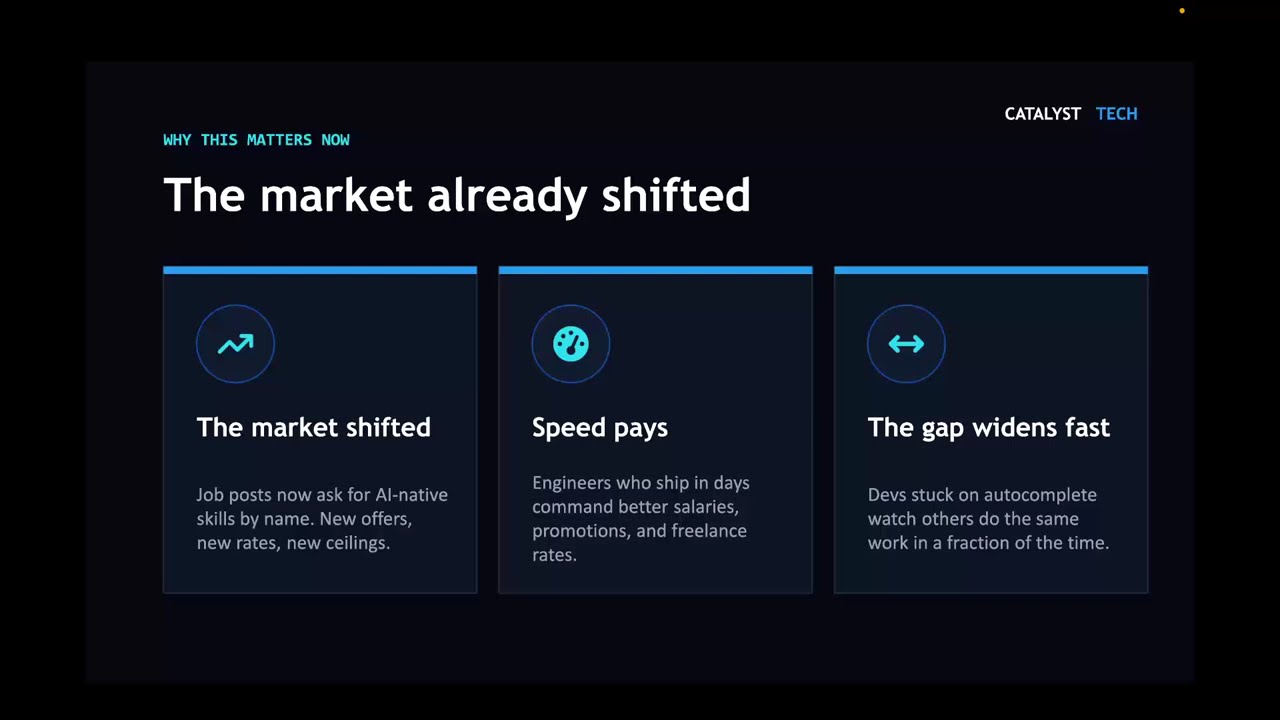
- Job posts now ask for AI-native skills explicitly. New offers, new rates, new ceilings.
- Engineers who ship in days command higher salaries, faster promotions, and better freelance rates.
- Devs stuck on autocomplete are watching peers do the same work in a fraction of the time.
Curriculum
10 modules
How modern backend engineers use AI as a delivery partner, not just autocomplete.
- - AI-assisted backend development mindset
- - Human vs AI responsibilities
- - Random prompting vs structured delivery
- - How AI changes backend workflows
- - How to review AI-generated work
Use specs as the source of truth before asking AI to build.
- - Product requirement to backend spec
- - User stories, API contracts, DB schema planning
- - Auth rules, validation rules, acceptance criteria
- - Implementation task breakdown
- - Context engineering inside the spec workflow
Build a project knowledge base - plus MCP tools - that AI agents can follow and call.
- - Project documentation base
- - Backend architecture docs, DB rules, API conventions, testing strategy
- - Agent instructions
- - Reusable skills: API features, migrations, bug fixing, testing, code review, RAG
- - MCPs (Model Context Protocol): connect AI agents to your backend tools, DB and APIs - and expose your own tools as an MCP server
The main practical backend module.
- - Database schema, migrations
- - Backend APIs, services, repositories
- - Validation, auth, pagination, filtering
- - Tests, documentation, AI-assisted code review
Use agents to implement backend work safely.
- - Local repo agents and cloud coding agents
- - GitHub issue to PR workflow
- - Parallel task execution and agent-generated branches
- - CI checks, reviewing diffs, safe delegation rules
Build your first AI-powered backend feature.
- - LLM API integration and chat endpoints
- - System, user, and assistant messages
- - Streaming vs non-streaming, conversation history
- - Cost tracking, rate limits, retries, timeouts
Understand and build semantic search systems.
- - Embeddings and vector similarity
- - Document chunks and metadata
- - Vector DB and pgvector concepts
- - Semantic search endpoint and ranking basics
Build backend systems that answer using private project data.
- - Document ingestion, text extraction, chunking, embeddings
- - Retrieval, prompt construction, answer generation, citations
- - Tenant isolation and prompt injection basics
- - RAG production mistakes to avoid
Build backend-controlled AI agents.
- - Difference between chatbot and agent
- - Tool calling and safe backend tools
- - Model Context Protocol (MCP): publish your backend tools as an MCP server so any AI client can call them safely
- - Permission checks, approval flows, action logs
- - Admin, support and ops agent examples
Ship AI backend features properly.
- - Logging, monitoring, prompt versioning
- - Token and cost tracking, rate limits, retries, timeouts
- - Fallback models, evals, security, prompt injection
- - Deployment concerns
Technologies you'll learn
Don't know them? Perfect. We teach everything.
What you'll build
Your project: AI-Powered Backend Assistant
By the end of the course you'll have built and reviewed a production-grade backend that ties all of the above together.
How it's delivered
- Format
- Recorded lessons - watch anytime
- Live sessions
- Weekly live sessions for support
- Support
- Lifetime Community Access
- Access
- Lifetime access
- Language
- Arabic
The offer
- Lifetime access to all lessons & updates
- Private community access
- WhatsApp support group
- 30-day money-back guarantee
Buying two programs together takes 20% off both - three takes 25%. See the programs
- 1 · Pay through the InstaPay link
- 2 · Screenshot the receipt
- 3 · Send it on WhatsApp - access activates within minutes
💳 Pay with Visa · Mastercard · InstaPay or any e-wallet
Questions
Start today - lifetime access, and every module still to come.
Still have questions?
Talk to our team before enrolling. Serious inquiries only.